Wednesday, May 27, 2009

Hurricane Season Is Here... Is Your Bird Ready?


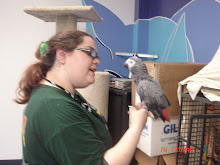
This room is full of birds and other exotic animals that were rescued from Galveston Island after Hurricane Ike

Hurricane Season is officially here for the Atlantic Basin and the first Tropical Low has formed.
What does this mean for bird owners like myself?
It means it's time to double check your preparations and put the finishing touches on training the behaviors that will help you in the event of an emergency.
But don't panic... if you are not prepared with an emergency kit and have not thought about what behaviors will be helpful in an emergency, it's not too late!

Here is a parrot disaster kit list that I put together with Code 3 Associates:

Food and Water

Food; two weeks supply – pelleted diets, seeds, dried fruits/veggies and nuts – in airtight container, rotated every 3 months

Small tubs of fruit salad in own juice is great as they provide fresh fruit and fluids but keep a long time.

Certain Baby foods are also good as they are mushy which is a comfort food for birds. Be careful as to vitamin and mineral supplementation which may be too high for a bird

Your birds favorite teats – rotated every 3 mo

Water; two week supply – estimate 1 to 2 quarts per day for drinking, bathing and cleaning

Food and water dishes – have extra and non breakable

Restraint and ID

ID - band number or microchip – have this information on your paperwork

Towels - wrap the avian in

Portable cage with perches - marked with your contact info

Recent photographs - including you or family member in picture

Wire, pliers, and duct tape – to repair portable cage

Wire cutters - to remove a stuck bird in an emergency

Sanitation

Newspapers for lining the cage

Paper towels

Dish soap

Disinfectant

Garbage bags


Care and Comfort

Blanket or sheet to cover cage

Toys

Hot water bottle

Flashlight w/extra batteries

Grooming supplies

Spray bottle for misting

Battery Powered fan - a small one can be attached to the cage and make the difference on a hot day

Records and medications

Vet phone number

Copies of proof of ownership papers

Copies of medical records

Medication – two week supply of any medication the bird is on

First aid Kit –

First aid book for Birds

3 X 5 conforming bandages

4 X 4 gauze pads

Graze rolls

Antiseptic wipes

Triple antibiotic cream

Q-tips

Scissors

Tweezers

Instant cold pack

Disposable gloves

Two rolls of vet wrap

Items in addition to basic kit

Pedialyte

Blunt nose scissors

Styptic powder

Cornflower – to stop bleeding on wings or soft tissue

Hemostat - for pulling broken blood feathers

Cotton swabs

Feeding syringes - incase hand feeding is needed)

NOTE: Birds are better being transported in the plastic animal kennels with a low perch, however this is not suitable for any longer than a day at the very most as most birds can chew through the plastic in short order.

Similarly cages (either small regular ones or collapsible travel ones) are dangerous for travel as the bird can easily panic and break wings or get them stuck in the bars.

Two cages are best, a travel cage and a collapsible wire one for when the destination has been reached.

Keep the disaster kit in an easy to grab and go bag or tub that is in a central location. If there the entrance that you keep the kit at is blocked it won't be of much use.

Make sure you know the best way to pack your car with people, animals, and supplies for both. Then be sure to plan at least 3 different routes out of town to your intended destinations (have more than one of these too!).

Finally make sure everyone in the family knows the plan.


If you must leave without your animals make sure you leave some indication on your house that you have animals and how many of each species. Inside the home in an obvious position leave basic care instructions, your emergency contact number, your out of state contact number and your vets number. This will allow emergency responders to care for your animals and get in contact with you.


Next post I will cover some behaviors which you can train to help you and emergency responders in an emergency.

Friday, May 8, 2009

Global Warming A Threat To Parrots

As this article on Tree Hugger shows, the threat to wild parrots is not only from direct human destruction of habitat and trapping, but also from our influence on Global Warming.

The islanders are evacuating their island to head for higher ground after the rise in sea levels have made their agricultural existence impossible.

They predict that the island will be under water by 2015 (that's only 6 years from now!). But while the humans have made it to safety, what of the wildlife that's left behind.
Many of our beloved birds are island dwellers in the Southern Pacific, so in 50 years, with sea levels rising the way they are, where will they be?

Please do your bit to end Global Warming (a lot of it will save you money over time too! Think of all the extra bird toys you can buy), and help to save our birds native habitat.

Thursday, April 30, 2009

Has Your Bird Got Rhythm?

According to scientist who studied the parrot celebrities Snowball and Alex, parrots are the first creatures apart from humans to be found to have rhythm.

They watched Snowball dancing to the Backstreet Boys played at different tempos and found that he adjusted his movements to match.

Now my birds are not really dancers... no matter how much I turn up the music and dance around like a fool. But every now and then Marnie will get into it and I have noticed she has close to perfect rhythm.

All in all, I think this is just another bit scientific proof that our birds are as intelligent and cognizant as we know they are

BBC Article on Dancing Birds

Saturday, April 11, 2009

The Loss of a Friend and the Terror of Fingerless Gloves


Well it's been a while since I updated on here (note to self... must get better about that), and a lot has happened. Some good, some bad and some kinda average.

In bad news, Inyoni, the spitfire 1 legged female lovebird has passed on to the rainbow bridge. Her energy and fire will be missed.
Her mate Ndeke was very quiet for a week after her death, but after a cage move around and he realised that he now gets all these awesome things like bird bread and warm mushy foods, and a happy hut because I no longer have to worry about these things triggering a laying session. So he's acting normally now... perhaps even a little more content now she is not demanding feedings and nagging him.
A necropsy was performed (I cannot stress the importance of this for any bird owning home) and no contagious cause of death was found. I had her cremated and am waiting for a nice day to take her ashes out to the greenbelt so she can fly free.

Darwin has been a cause for concern as he had a seizure last week (possibly he had one in January too). I stepped him up to put him in the travel cage to go to the vet for a nail trim (he's squirmy and I have not trained the nail trimming behavior with him yet), as he came out of the cage he just dropped from my hand and was seizing on the floor. I scooped him up and into the travel cage and hit the road to the vet (calling them to let them know I was bringing in an emergency). After about half an hour he came back from the far away gaze and was his normal self.
Gram stains showed nothing and we pulled blood for CBC and Chlamydiosis on Monday... everything came back normal with the slight exception of his Calcium which was on the low end of normal... so we are going to up his calcium intake and retest in a month... hopefully this will be the cause.

I think it important here to share some of the foods I will be adding to his diet (remember, he's on the allergy diet of rice pellets... he just recently started getting an organic allergen free sprout mix).
So, now I am hanging fresh organic dandelion leaves in his cage (he is unimpressed), offering a small bite of cheese every day, and almonds.

I also finally bought full spectrum lighting, after much research about the issue of CRI, Kelvin and flickering. My research identified the minimum CRI and Kelvin and informed me that the issue of flickering was all down to the base. Older bases were not designed to keep the flicker rate down, but that there should not be any problems with flicker with newer bases.
So I bought two full spectrum bulbs from featherbrite and a clamp light with a cage over the bulb (this is found in the reptile section). The stronger watt bulb is in the overhead light in the bird room, and the clamp light shines the other one direct on his cage... I really like how it turned out and am already planning on getting a second clamp light and bulb to brighten up Ndeke's lower cage.

And then there is Marnie.
I recently tried wearing elasticated fingerless gloves to help with my arthritis, and Marnie was not impressed!
Although she would take food from my gloved hand, and allowed me to scritch her with it, she would not step up on it... I'm not sure if it was the look or it or the feel, but she was having none of it.
So desensitization started.
I started by having her on my lap and slowly brought the gloved hand closer and closer, consistently reinforcing calm behavior. Eventually I had my gloved hand right next to her feet and from there I slowly began to touch them with the fabric, and finally I put my gloved hand flat on my leg and used the treat to persuade her to step on to it. Once onto the gloved hand I reinforced her for that and staying on there... and now she steps up onto the gloved hand without hesitation!

Finally, check out the Austin Parrot Society for info on our next meeting, a foraging toy workshop, and let me know if you want to be added to the mailing list!

Sunday, March 8, 2009

Training Update 03/08/2009

Time for a training update... it's been long enough!

Lucha is still in his hormonal amazon season and is very difficult to work with. I was lucky to get a few repetitions in of the taking liquid from a syringe behavior the other day before the eyes and tail flashed and the whining started.

Darwin is still working on his recall... he's still a little hesitant, but I am happy to say that with patience and a few repetitions of the request he is coming down from the very top of the playscape every time. I will of course be continuing to work on recall, but would like to add specific areas to cue him to.

Marnie surprised me today. Normally when I attempt to target with her she gives me the "why?" look. So when I decided to start the taking liquid from a syringe behavior with her I was unsure of how well we'd progress.
So I showed her the syringe, she touched it with her beak, I bridged and reinforced. After a couple of slow repetitions I decided to add liquid to the syringe (some lukewarm chamomile tea, one of her favs). Well that turned out to be great for Marnie. The first time she touched the syringe tip with the liquid, she lost all interest in the chopped almonds in my hand and proceeded to drink the whole 1cc of chamomile tea in one go! I refilled with water and got exactly the same reaction :)
Thinking back this should have been obvious, as Marnie often demands a taste of whatever I am drinking and hissy fits are thrown if I am drinking something like coffee and deny her request. So even though the liquid was in a syringe and not a cup, it was still hugely reinforcing for her to get the contents...
... but with sucess comes failure. I asked her for a turnaround and she stared at me...

Marnie giving her patented "Why?" look

Monday, February 23, 2009

Catching Up on Things

Well it has been hectic here and I haven't posted in a while, but I feel sufficiently guilty and promise to work harder on it in the future... honest!

Training News
Training is on hold for breeding season for Lucha. Although I was having problems with focusing when we were working on crate training on the floor (my toes are a high value reinforcer apparently), he has now gotten to the point where any attention quickly leads to eye pinning, cheek puffing and tail fanning, quickly followed by a display illustrating just what a handsome amazon he is. I am lucky in that for the most part, I can still get him to step up when in this mode and move him back and forward from cage to playscape... but training is just way to overstimulating and he gets focused on displaying and not training.

Marnie is still a little smarty pants know it all... she has been a little fussy about stepping up to go to bed (after all, she's 7 now and can stay up late and watch horror movies or so she tells me), but I have been working on that by getting the treat and doing a short (1 minute) run through of turns, waves and shakes, before asking for the step up and giving it to her on the way to the cage for bed.

Darwin is still an adorable little snot, still looking for his forever home and still recalling.
He still hesitates a little when I am asking him to come down from the top of the playscape, but time, patience and consistency will approve his reaction time after the cue. Next up I think I will start teaching him some silly parrot tricks such as turn around and wave.

Austin Parrot Society
We had our first meeting yesterday and I have to say I was very happy and impressed with the folks that came. 16 of us in total, but we all seemed to have the same goals and concerns for our parrots. I am really looking forward to developing the society as a focal point for the parrot community in Austin... more details on the meeting can be found at the Austin Parrot Society Blog

Wings of Love Bird Haven
I spent valentines weekend up at Bird Haven with my friend and Partner In Crime Emily. I spent the time educating the volunteers and the birds on positive reinforcement. I was really wonderfull to see almost every bird really get into the training and improve with just two short sessions. I will do a proper write up about this weekend soon.

From Beaks to Barks
Speaking of Emily, she is my pet sitter as well as my friend, and she has featured my birds as February's Pet of the Month on her Blog.
Check it out Here

Tuesday, February 10, 2009

Weatherford Parrots Update

I would like to thank everyone who responded to my original post with offers of help and/or donations. Much has happened since then, and I wanted to give everyone an update so that you can direct your energies and assistance in the most productive way possible with minimal confusion or wasted time.

GREAT NEWS: Parker County Animal Shelter has talked the city out of auctioning off or euthanizing any of the birds! All birds that are considered “unadoptable” are being sent to reputable sanctuaries, where they can live out their days in ease. As for the rest of the birds, they are either being adopted directly out of the shelter itself, or passed on to a few reputable rescue groups. Last time I spoke with the shelter director, they were still sorting out which rescues were getting birds. For right now, they are going to try to keep as many in-house as possible. *If you do not live in Parker County, they will not adopt a bird out to you.* So, contrary to my last post, most of you are not eligible to adopt birds through them. This may change, but for now they want to keep their birds within the county. I will not keep posting updates about the shelter. To keep up with the latest news yourself, or to make a donation to them, please visit their website: http://www.petfinder.com/shelters/TX54.html

Having said all of that, Wings of Love Bird Haven took in another two birds this week, one of which is a macaw in very poor condition. So, while much of the immediate crisis of auctions has been averted, Bird Haven is still in desperate need of help. These are their specific needs (anyone who makes a donation can get a receipt for tax purposes):

* Monetary donations to cover medical expenses, purchase food, cages, and other supplies.
* Large cages that will house Greys and Eclectus all the way up to Macaws and Cockatoos
* Organic, dye-free pelleted food and/or fresh, organic produce
* Sprout seeds
* Newspapers

My friend and I are still heading up to Bird-Haven this weekend, so if you want to make donations in kind (sprouts, veggies, newspaper, pellets etc) then please let me know and I will come and pick up this week.

They do not need toys or smaller cages right now, although they might in the future.

And of course, as always, they are in need of good foster or permanent adoptive homes.

To make a donation, contact Bird Haven directly with any questions, or to fill out foster or adoption applications, please visit: www.bird-haven.org